
In the Particular is Contained the Universal
James Joyce, Mustard Seeds, and the Power of Ordinary Moments

The Pub Crawl
While in Ireland in 2016, I had a couple of free evenings in Dublin, so I set out on a Literary Pub Crawl. For two-and-a-half hours, professional actors led us through Dublin’s historical literary sites and pubs, bringing the words of famous Irish writers like Joyce, Beckett, and Wilde to life.
A few blocks down Anne Street from St. Ann’s Church of Ireland, we came to Kehoe’s Heritage Pub, established in 1803. As we approached this particular pub, I noticed a mural on the corner, almost tucked away on the side street, so I stepped over to see what it said.
At the top was a quote attributed to James Joyce that has since played a significant role in my life, especially my writing life.
“In the particular is contained the universal”
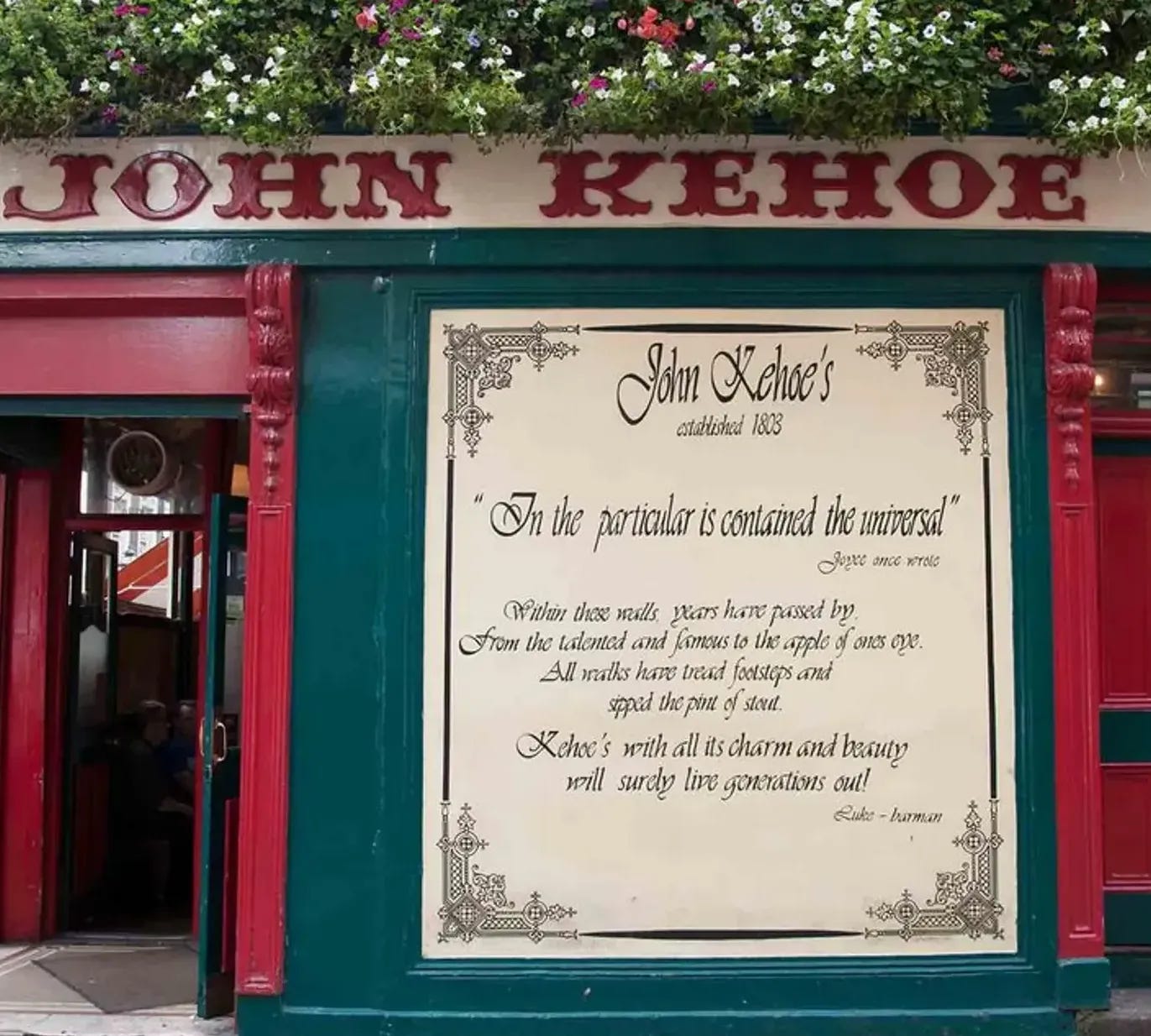
The Heartbeat of Joyce’s Work
Joyce may not have written these exact words, but they capture the heartbeat of his work. By focusing on minute details of individual experiences, characters, and local events, Joyce revealed broader truths about humanity, society and existence.
As a writer, Joyce was reacting against a cultural movement toward abstract and generalized storytelling. He believed that such universal ideas were best understood through careful attention to the small, particular, and mundane details of the human experience.
In his work, Ulysses, for example, Joyce depicts an ordinary day in the life of Leopold Bloom. Bloom buys breakfast, walks through the streets, thinks about his letters, and interacts briefly with strangers. Every event seems utterly trivial and insignificant. But as Joyce immerses the reader in the inner thoughts and perceptions of his character, we are invited into the universal human experiences of curiosity, loneliness, desire, moral reflection, and the search for meaning.
Joyce frequently uses sudden flashes of insight that emerge from the mundane. By noticing the textures, sensations, sounds… every tiny detail of the moment, the reader is lifted into a deeper awareness of something vast and timeless.
The quote on that wall didn’t just shape Joyce’s writings. It began to shape how I saw my own story.
Stories That Don’t Seem Worth Telling
This single phrase, “In the particular is contained the universal,” is the one truth that gives me the will to write at all. Most of the time I feel like my story simply isn’t worth telling. As they said in the Baptist Church of my teenage years, my “testimony” was not compelling. I never hit rock bottom. I didn’t even come close. My life wasn’t perfect, but it didn’t feel like a pit I needed Jesus to pull me out of. It was just ordinary.
But those stories of radical transformation were the ones featured on the church platform, and I couldn’t relate. If I had taken even one step down those dark paths, I’m not sure I would have lived to tell the salvation story. I was too afraid of my parents to get into any “serious sin.”
In seminary, I had to create a couple of “spiritual timelines” to trace God’s movement in my life. At first, my story felt too uneventful to chart. But as I mapped the seasons and transitions in my life, I noticed threads of grace in the little things I thought nobody would care about. Those were the moments that shaped me most.
It brought me back to one seemingly insignificant event that has strengthened me through decades of ministry.
The Arm-Wrestling Match
I was 22 and serving alongside my friend Tim with the youth ministry at our church. Most of our students were not church kids and many of their families did not attend our church. I started a youth band with a few of them to lead worship and helped with planning and other behind-the-scenes work to support the ministry.
Many days I would go over to Tim’s house and try to quit because I didn’t feel like I was effective. I just wasn’t connecting with the students.
But every time I tried to leave, Tim drew me back in. He encouraged me and told me to pray about it, but in the meantime, he would ask me to help with one more simple task. He never gave me an out. Years later I asked him about it, and he confirmed that it was intentional. I am grateful for his persistence and for what he saw in me that I couldn’t see at the time.
One night in youth, the toughest athlete in our group was challenging everyone to arm wrestling. When he got around to me, I surprisingly won. Whether by a fluke or by the power of the Spirit, I may never know. But from that point forward, he stuck to me like glue. He wanted a rematch, but I wasn’t stupid. I knew I had just gotten lucky. Still, this one trivial event earned me more respect from him and some of the other teenagers than I could have imagined.
As a result, he also began to pay closer attention to the things I said. By the time we went to the fall retreat, he sat up most of the night with me and poured out his heart. As we reflected on that prayerful and transformative night, Tim reminded me that it was the little things that mattered. That one arm wrestling match moved this student to a place where he respected me, and in turn paid close enough attention to see Christ in me in a way that opened him up to God’s grace.
For the first time in my life, I felt empowered in ministry, not because of anything I intentionally tried to do, but by just being willing to make what I thought was an insignificant connection with a student on his terms. God’s grace is greater than my plans, and often works in spite of them.
I learned that it is the little things that matter to people. It doesn’t matter what you preach or teach or sing or what events you plan. God uses the little points of relational connection to bring about big fruit.
And in all honesty, the repetition of that very lesson over and over again is the only reason I’m still in ministry 24 years later.
The Universal in the Mundane
You might have one of those great “testimony” stories worthy of the stage, or a huge publishing contract, and if so I hope you take advantage of every opportunity to encourage and empower others through your story.
But I imagine there are at least as many people like me who feel like their story is just not worth telling. It’s too small. Too trivial. Too mundane.
Funny how easily I dismiss the little things in my own life when Jesus’ greatest hits were about things like sparrows, lilies, yeast, or tiny coins.
Maybe there’s more to be said for seemingly insignificant moments than we realize. Maybe Jesus and James Joyce were right. In a tiny grain of mustard is found a universal truth about the power of faith. In every tiny detail of life, there is something deeper that points us to the universal wisdom of the ages.
People like me can’t relate to the big transformation stories, the rags to riches trope, the recovery experiences, or any of the other narratives that take the spotlights in our world. But every one of us can relate to the little ordinary things, the things nobody thinks are worth talking about.
If it’s true that the universal is contained in the particular, as Joyce modeled in his writings, then these are the stories that must be told.
These are the stories that make us human.
The stories that help us feel seen.
The stories that remind us of God’s presence in the ordinary moments.
The stories that break down barriers
and connect us all.
Have you ever noticed how a small, ordinary moment revealed something larger about God, about life, or about yourself?
I’d love to hear one of your ‘particulars’ that contains a universal truth.
These reflections are always offered freely. If they’ve been meaningful to you, you can support my work by buying me a coffee as a small gesture of encouragement. Thank you for reading and journeying alongside me

Next Week - Patient Trust
A reflection on the poem by Pierre Teilhard de Chardin and our role in the ongoing work of Creation.
Craig,
Thank you for this beautifully reflective piece. I deeply resonate with the idea that “in the particular is contained the universal.” Scripture consistently affirms this. Jesus rarely built His teaching on grand abstractions; He spoke of mustard seeds, sparrows, bread, lamps, coins, vineyards, and fishing nets. The Kingdom of God was revealed not in spectacle but in the ordinary rhythms of life. That alone tells us something profound: God is not only present in the dramatic, but He is faithfully present in the mundane.
Your honesty about feeling your story was “too ordinary” is refreshing. Many believers quietly carry that same tension. Yet biblically, faithfulness often looks less like dramatic rescue and more like steady formation. Galatians 6:9 reminds us not to grow weary in doing good, precisely because transformation is often incremental, relational, and unseen.
Your arm-wrestling story captures this beautifully. What seemed trivial became relational currency that opened spiritual space. That mirrors how Jesus built connection: eating meals, walking roads, and noticing individuals others overlooked. Small moments became sacred bridges.
To answer your question: one “particular” I often reflect on is simply listening to someone in pain without rushing to fix it. Again and again, I’ve seen that quiet presence communicate God’s compassion more powerfully than eloquent words. Sometimes the universal truth is this: people experience God not through our perfection, but through our availability.
Thank you for reminding us that testimony isn’t measured by drama but by grace. The ordinary life, attentively lived, is often where God’s deepest work unfolds.
Blessings,
Ze Selassie
It's funny that right before I read your article I read of the same concept in a Richard Rohr book. He says that Hebrew Scripture scholar, Walter Brueggemann, calls it "the scandal of the particular". Rohr described it several different ways. One of my favorites was "the specific to the spacious". It made me think of how one awestruck moment like coming upon a wildflower or a waterfall or even a person in need can open up space in your heart & spirit. Thank you so much for your thoughtful messages.