
An Altar Wrapped in Flags
How nationalism reshapes our worship

Everybody in town showed up for church that day. A huge community wide choir and full orchestra would play the greatest cantata of the year. A must-see event for everyone, whether they ever went to church or not.
Christmas?
No.
Easter?
Not quite.
But if this church’s annual programming was any indication, it was bigger than both of those by far.
It was Fourth of July Weekend… the day we celebrate Jesus… I mean, American soldiers fighting for our freedom.
Or maybe it was about Jesus fighting alongside our soldiers, as if God were always on our side.
This wasn’t a milestone anniversary of our nation. Nothing of particular historical significance had occurred that year, or any other year the town gathered at church to sing their favorite American anthems in place of the usual hymns of faith. It’s simply that this event, above all others, was what the church was known for, and they prepared for it all year long as if it were the Macy’s Thanksgiving Day Parade.
The Unquestioned Liturgy
A citizen of France visited our small country church while in town on business because one of his employees invited him. He came as a Christian to worship God with the body of Christ here in the states while he was visiting.
As the service began, everyone put their hands on their hearts and turned toward the stars and stripes. He hesitated and awkwardly followed their lead. But he did not recite the words.
Would any good American pledge their allegiance to the French flag while visiting Notre Dame? Or swear loyalty to any nation where they were visiting, especially in worship?
Reciting our national loyalty came first. The call to worship the God of all nations, second.
When did the flag become the door one has to enter before kneeling at the cross?
Fortunately, we ended that practice shortly after I arrived, though not without controversy. And I honestly don’t know if they brought it back when I left.
Kneeling Before the Flag
Communion Sunday.
We kneel at the altar railing to receive the body and blood of Christ, who died for the sins of the world.
The altar is wrapped in flags.
The rail is covered in red, white, and blue.
It was Labor Day weekend.
Not even one of the big patriotic holidays.
Don’t worry. The same flags came out for Memorial Day, Fourth of July, Veterans Day, and just about any other time they could get away with it.
As the pastor, I served communion that day, but I did not receive it.
Some say I’m overreacting, but something feels deeply problematic in kneeling before the symbols of one empire in order to remember the one who was crucified by another.
The Cost of a Flinch
I flinched at the first volley. Even when I know it is coming, a 21-gun salute always catches me off guard.
I felt a tug at the sleeve of my clergy robe as a member of the congregation immediately pulled me aside. With both his hands on my shoulders and only my Bible between us, he glared directly in my eyes and scowled, “Don’t you dare stand here in my church’s cemetery and disrespect our country, our soldiers, and our flag like that!”
I intended no disrespect. My physical reaction was entirely involuntary, but it didn’t matter. He later made it clear that I would never preach in that church again, and within less than a year, he got his wish.
This Wasn’t the Exception
Each of these vignettes comes from my own experience, long before the current arguments over Christian nationalism became headline news. It was just part of the culture, and nobody saw a problem with it.
They did, however, have a big problem with anyone who wasn’t as enthusiastic about it as they were.
Don’t get me wrong. I’m not knocking Fourth of July celebrations, military salutes, or any other means of showing gratitude for our country. I’m not anti-patriotic, though I do believe that true patriotism requires working to right the wrongs of our nation as much as it celebrates what is good. For some, I guess that makes me anti-American.
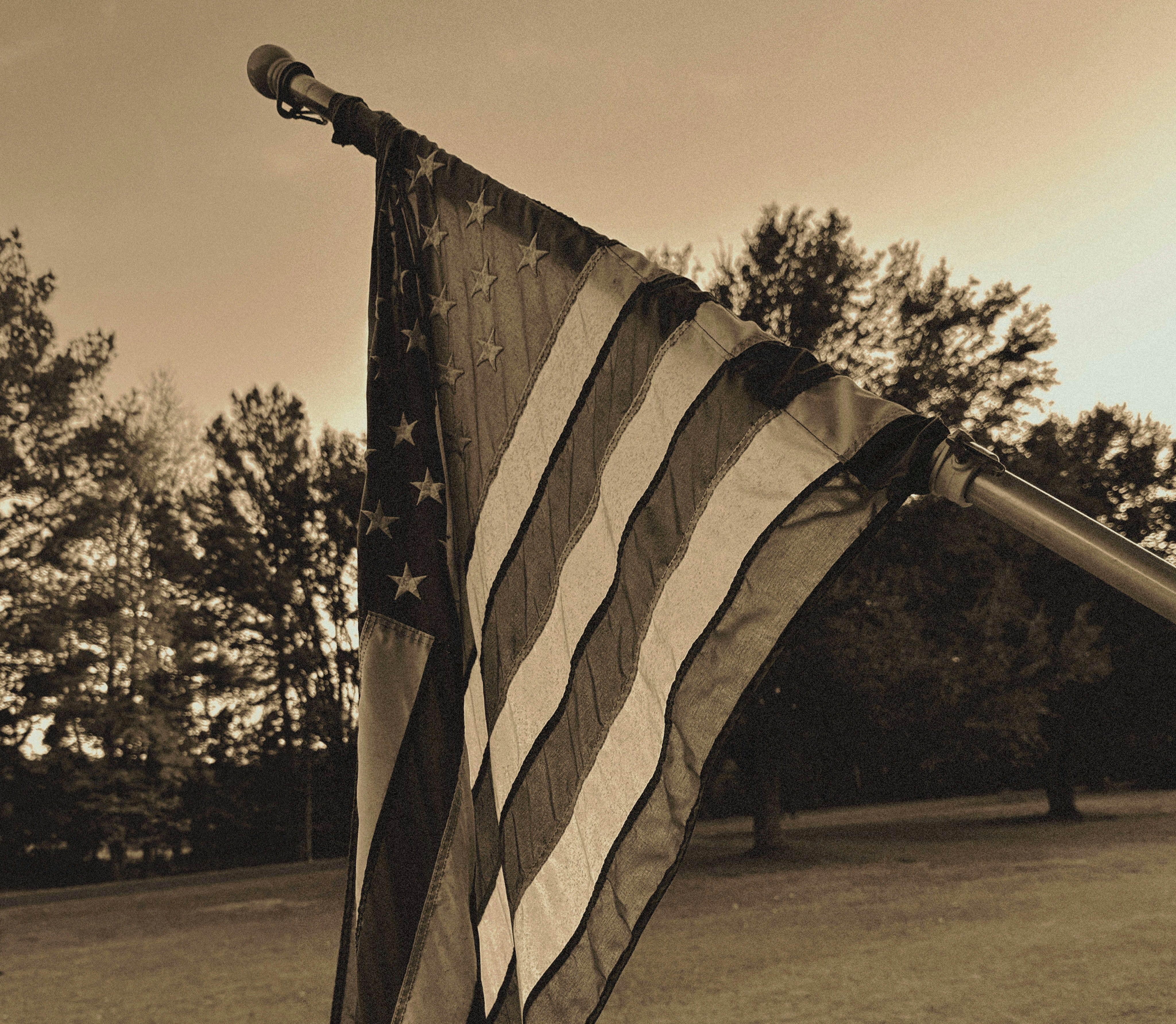
Love of Country is Not the Point
Growing up in the Baltimore County Schools, I went on field trips to Fort McHenry and looked out on the bay where the Star-Spangled Banner was penned, and to Philadelphia where the Declaration of Independence was signed. I regularly visited the monuments and museums in Washington DC and the heritage sites at Jamestown, Yorktown, and Williamsburg.
We used to walk to the end of our street for the annual Fourth of July Parade, complete with school marching bands and every fire truck in town. Sometimes we went to the Inner Harbor for the fireworks and if we couldn’t make it downtown, you could be sure that Pops Goes the Fourth would be playing on our TV.
I even used to celebrate Flag Day and Constitution Day by parading around the yard with every historical American flag I had, including a US Constitution Flag. I was a huge flag collector in elementary school.
I grew up in Scouts where I learned “to do my best to do my duty to God and my country” and spent a decent amount of time with my grandfather at the Sons of the American Legion. I once even had to recite the preamble to the constitution and give a speech on it.
Few people today know this side of my story.
Many think I hate America because I don’t vote the way they do or support the policies and leaders they support.
Admittedly I was a lot more patriotic when I was a kid. I think many of us were. We’ve seen too much and we know that as a nation, we can and must do so much better. We are heartbroken by who we have become.
Church Was Different
But even with all my patriotic fervor growing up in the middle of colonial history in the mid-Atlantic, I never saw it in church. That’s not to say that it wasn’t more common in countless churches across the country, but it wasn’t prevalent in mine.
We didn’t celebrate patriotic holidays in my Catholic church growing up. The members there were among the most patriotic people I knew, but I always understood those celebrations as community events rather than church events.
There was a clear distinction, and for good reason. It wasn’t that the church was anti-American. It was that the church had a different purpose.
We went to parades and picnics and fireworks displays to celebrate our nation. We went to church to worship the God who loved the entire world.
If the church is known for our national pride more than for any other ministry throughout the year, what message are we sending about Jesus?
When the Church Blesses Empire
There is no question that Christian nationalism has exploded to levels I never even imagined as a kid. We have baptized every act of violence, war, injustice, and even moral scandal in the name of Christ and declared ourselves God’s chosen people for such a time as this.
Political leaders read Bible verses about humility while embodying anything but, and the church cheers as if Christ himself is endorsing them.
Though you wouldn’t know it from the ministries that bear his name today, Rev. Billy Graham once said,
I don’t want to see religious bigotry in any form. It would disturb me if there was a wedding between the religious fundamentalists and the political right. The hard right has no interest in religion except to manipulate it.
In fairness, the same principle holds true for the left, but Graham seemed to notice the danger more on the right, at least in his day as in ours.
As We Approach 250 Years…
I said the Pledge of Allegiance every morning along with every other school kid in America.
I took it for granted.
I assumed it was true.
I believed we were a republic where the people’s best interests were represented by our leaders.
I believed we were one nation “under” God, not before God, as is so often conveyed in today’s political landscape.
I believed in liberty and justice for all, but saying the “all” part now makes me “woke.”
There is something beautiful about patriotism that honors our shared values as one nation, indivisible, working together for the flourishing of all.
But “indivisible” does not reflect reality. The illusion of unity is shattered. We no longer even try to pretend.
There truly are places where the heart of Christ and the heart of the American people are in sync. Places where we still love our neighbor. Places where we still care for the poor and the marginalized. Places where we still fight for justice and equality. Places where we work to build up and not tear down, to heal and not to kill, to reconcile and not to divide. There are places, often where we least expect, where love and compassion cut through the darkness.
This Fourth of July, I want to honor those places where the Kingdom of God is breaking through, even in small ways, on earth as it is in heaven.
But I cannot pretend that this is the desire of those who hold power over us. This is not the way of the empire. It is not the way of the merchants or kings who weep from a distance as their kingdom crumbles around them in Revelation 18. It is not the way of the religious leaders who have sold their souls for the wealth, the comfort, and the influence of the powerful.
I don’t know if America has ever been great. I don’t know if it can be.
But I know what Jesus said about greatness.
Whoever wants to become great among you must be your servant … (Mark 10:43-45).
Whoever humbles themselves like this little child will be the greatest in the kingdom of heaven (Matthew 18:4).
Whoever is least among you all is the greatest (Luke 9:48b)
Like James and John, we want to be great in the kingdom. But I’m still asking: which kingdom are we seeking?
We’ve wrapped far more than the altar in flags.
Seek First
Seek first the Kingdom of God—
That’s what they taught me.
But now it’s here.

New Jerusalem?

No.
It’s called America.

Is it like a mustard seed,
or a pinch of yeast,
quietly working beneath the surface?

No.
It’s a lion roaring in broad daylight—
big, bold, and feared.

Does it open its gates
to the outcast,
the lame, the meek, the poor?

No.
It’s built on self-reliance and ambition,
where the rich and strong sit high.

Surely it’s humble,
servant of all,
the last shall be first?

No!

Where did you get such a wild idea?

We’re proud of our kingdom.
The world will serve us.
Losers last—
America first.

Dazed and confused,
I turn away—

Kingdom of God,
or mirror universe?
When the church prays, “Thy Kingdom Come,” I’m no longer certain which kingdom we’re praying for.
These reflections are always offered freely. If they’ve been meaningful to you, you can support my work by buying me a coffee as a small gesture of encouragement. Thank you for reading and journeying alongside me.

Coming Up:
Over the next couple of week’s I’m going to be sharing some of my “top shelf books,” the ones that have most inspired me throughout my life and have shaped my motivation for writing in the first place. They are not all the ones you might expect.
Hope to see you here next Thursday.
If you’d like to explore more of my writing…

Love it!
Thank you for this powerful and timely piece!